
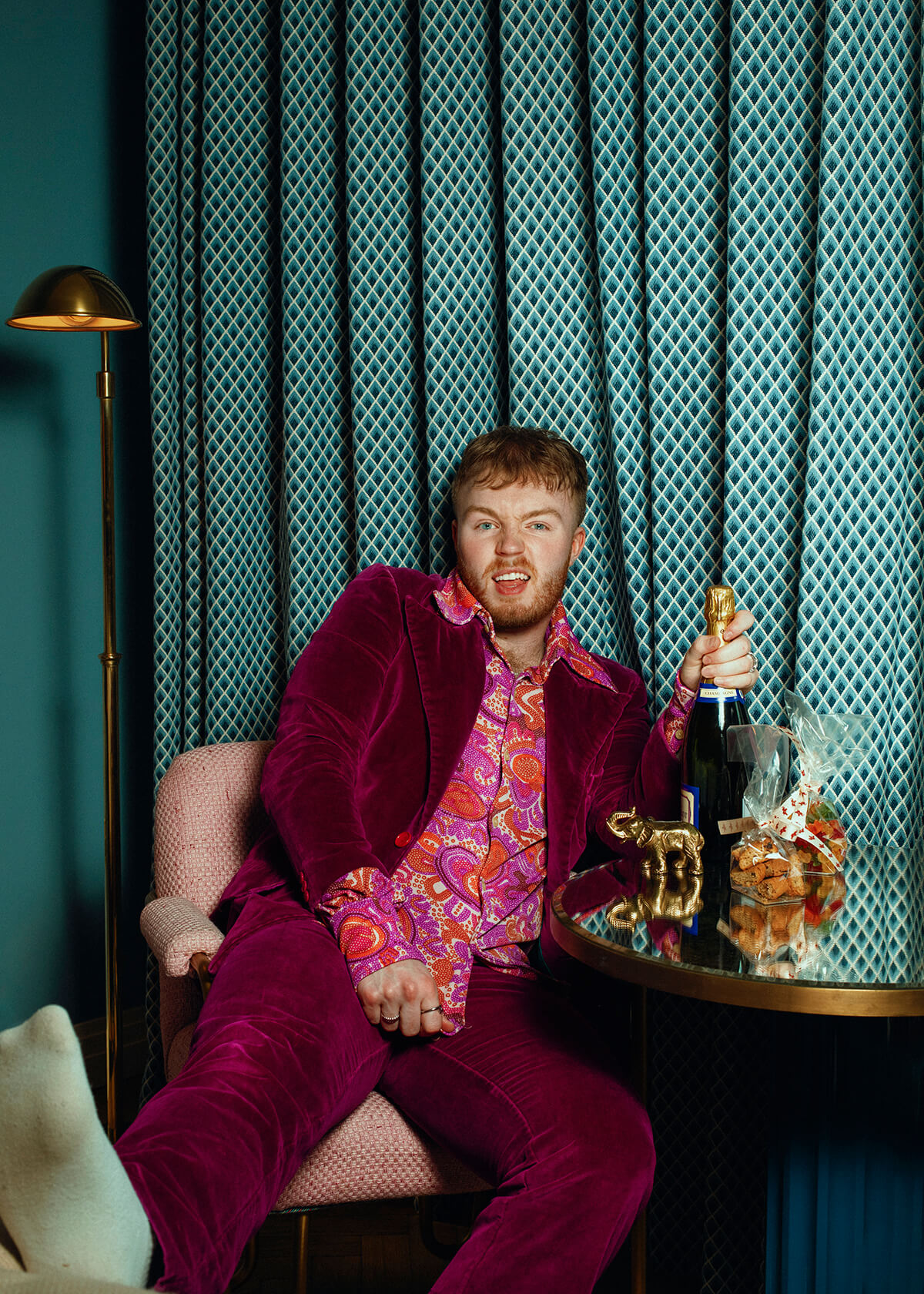
If you reviewed your own show, how would you describe it?
I’d say it’s tightly-written and self-aware. A mixture of gags, stories and thought-provoking routines with fresh premises. The kind of bits that clip up well for online short-form content. If you ask me, this kid’s gonna go far. He’s got chutzpah. He’s got charisma to burn, and a winning smile. He’s got “it”, whatever “it” is. *chews on corner of cigar*
Tell me a little more about your show and what audiences can expect?
The show is about the lies we tell ourselves to protect our egos. Most people like to think their beliefs are the product of careful reasoning, but I believe they’re usually emotional instincts that we’ve reverse-engineered an explanation for afterwards. This applies just as much to me as it does to anyone else. In practical terms, audiences can expect stand-up comedy. There are no projections, no interpretive dance sequences and no audience participation. It is mostly jokes.
To be honest, I don’t really want to tell people what to expect. I always think that answer sounds a bit artificial. If you’d like to know what my stand-up is like, the easiest thing to do is watch one of my videos online.
Can you talk about some of the creative team involved?
Bobby Mair directed my last show, and helped with this one too. He’s a tad darker than me though, material-wise. Sometimes he suggests that my routines could be improved by an act-out of me jacking off onto a dead kid’s face, and I have to politely pour cold water on the idea.
I’ve also received input from some of my very talented comedian friends: Sam Eley, Gbemi Oladipo, Ed Night, Dan Tiernan, Eric Rushton, Bella Hull, Omar Badawy. I’m grateful every day for my funny friends.
Where do you draw inspiration from for your work, both in terms of creation and performance?
I’ve watched a lot of comedy since I was a kid, and it has poisoned my brain. I’ve also always made a concerted effort to be as funny as possible, on the assumption that humour is the only thing standing between me and social exile.
I also consume an alarming quantity of podcast clips featuring alpha males explaining the importance of “manning up” over footage of strangers doing deadlifts. I find this content incredibly motivating. It inspires me to optimise my punchlines, dominate green rooms, leverage my personal brand, embrace radical accountability, crush my enemies, and acquire a sustainable pipeline of bitches. Every morning I ask myself: what would a man with a Bugatti do in this situation?
Looking at this production, how would you say it links to previous work personally and thematically?
I’m still exploring many of the same themes as my previous work, particularly privilege, identity and the absence of obvious hardship. However, I’m approaching them in a more self-deprecating and analytical way than before.
I’m still fascinated by the fact that, on paper, I’ve had a relatively fortunate and stable life, yet continue to display bouts of erratic, self-destructive and occasionally baffling behaviour. A lot of the show is an attempt to reconcile those two facts.
The main difference is that this is less a show about youth. Previous work often relied on the audience seeing me as a young man stumbling through life. At 27, that becomes a harder sell. Although I am considering wearing a propeller hat, carrying a giant lollipop, and using an air gun to shoot toy soldiers off a radiator. In many ways, that is the thematic through-line connecting all my work.
Why is this an important story to tell?
It’s absolutely not, and if you want an “important story” you should go see a different show.
What would you like audiences to take away from seeing you at the Fringe?
Ideally, my merch.
Beyond that, I’d like audiences to leave feeling slightly lighter than when they arrived. The world can often feel overwhelming, absurd and occasionally terrifying, and one of comedy’s oldest functions is to provide temporary relief from all that.
Also my merch.
Do you tend to take inspiration from events happening in the world around you in terms of your work? Do you think artists have a responsibility to respond to what’s happening?
All art is inspired by what’s happening in the world. If nothing happened, there’d be no art. Even choosing to ignore current events is itself a response to the world you’re living in.
Do I think artists have a responsibility to respond to what’s happening? Yes. Absolutely.
That’s why I’ve always been so critical of Monet’s Water Lilies. Beautiful paintings, obviously, but they completely fail to engage with the geopolitical realities of the late 19 Century. Not a word about colonialism. Not a single water lily addresses the Dreyfus Affair. Frankly, it’s irresponsible. Fuck Monet.
What do you do to relax in August?
Valium.
How do you feel about the current arts landscape in your country and your part in it? Does it excite you and inspire you to keep pushing the boat out?
Absolutely! I’m so excited. I want to keep pushing that boat out. I want that boat to get lost at sea, never to be found, like Bin Laden.
I’m biased, but I think my peers are some of the most talented comedians ever. The material they are doing feels completely fresh. It feels braver, broader, more inclusive. The era of going onstage in a suit, doing observations about Ryan Air and self check-out machines has long disappeared.
Nobody has to try to make their act commercially viable because they can build their own audience online. If you’re going to the Fringe this year, get ready to see young comedians doing niche material that feels ultra-authentic.
Why are arts festivals such as the Fringe so important for international exchange?
At a festival, you often end up seeing work from countries, languages and traditions you’d never actively seek out. Someone goes to see a clown show and accidentally learns something about contemporary Argentina. Without festivals, cultural exchange tends to be dominated by the largest economies.
An American booker came to one of my shows once and booked me on some American cruise ships from it. To be honest, I think that did more for Anglo-US relations than the Marshall Plan.
What can the wider arts community do to get more people involved in their specific disciplines?
They can subsidise the arts lol. It’s not exactly The Da Vinci Code.
Have you got your eye on any other shows that are part of the programme?
I haven’t looked at the programme but I want to see Phil Ellis, Eric Rushton and Chris Kent for sure.
What’s next for you and how are you feeling about the future in general?
If I had some grand plan for my success, I’d be disappointed very quickly. Luckily comedy has many avenues for success, and if the industry completely rejects me, I always have my YouTube.
How can Edinburgh audiences keep up with you beyond the festival?
YouTube and Instagram. I have hours of content out there
Anything else?
Ted Kaczynski took part in psychological experiments at Harvard under a researcher connected to MKUltra, the CIA mind-control programme. I’m not saying that’s why he became the Unabomber. I’m just saying if you’re the CIA, and one of the people who goes through your mind-control experiments later becomes the Unabomber, that’s a bit sus.
Finlay Christie: Champagne Casanova, Monkey Barrel Comedy, until 30 Aug (not 18), various times