
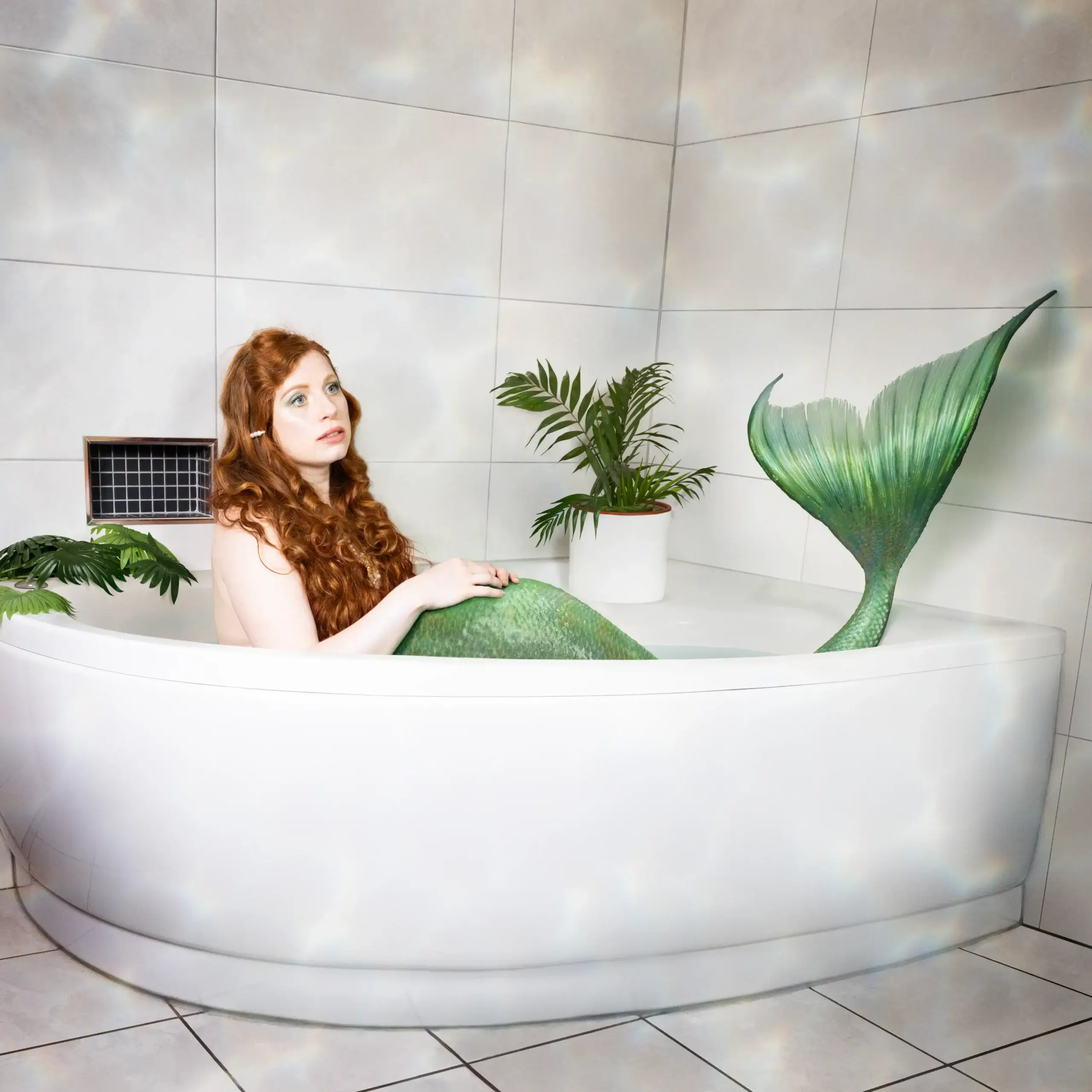
If you reviewed your own show, how would you describe it?
Mystical, magical, funny, dark, wet.
Tell me a little more about your show and what audiences can expect?
The show is all about mermaids and wanting to be a mermaid, and about being a girl in the mid 2000s in general and why it was a rubbish time to be growing up and into your body. So it’s about sex and body issues, but from someone who is very prudish and hates talking about that kind of thing. So if explicit comedy isn’t your thing, don’t worry! It’s not mine either. Also it’s very funny.
Can you talk about some of the creative team involved?
My friend Julia is making me an incredible costume and some equally incredible props. Last time for Haunted House, she made me a beautifully intricate haunted dollshouse which went above and beyond what I expected. I would urge any comedian who needs a weird prop built or a creative eye cast on a show to go to Julia.
And Jake is back as my tech for the second time in a row. Techs are the real heroes of the Fringe – they have to sit in a dark hot room all month watching the same show on a loop. It’s a wonder they haven’t gone Jack Torrance on us.
Where do you draw inspiration from for your work, both in terms of creation and performance?
I love stories and storytelling and myths and legends. Last time the show was all about ghosts and I got to research lots of ‘true’ ghost stories. This time its mermaids and sea creatures and I’ve been reading real life accounts of mermaid sightings, including one by Christopher Columbus.
Other than that I try to get inspiration from the world around me, my own life and other comics I admire.
Looking at this production, how would you say it links to previous work personally and thematically?
Both this show and Haunted House are about me growing up, the last one was about being from Edinburgh, this one is about being a girl in the mid 2000s. They also both weave in my love of myths, legends and eerie tales.
Do you tend to take inspiration from events happening in the world around you in terms of your work? Do you think artists have a responsibility to respond to what’s happening?
Yes and no. I think art should and can be escapist and enjoyable but also a lens through which to see the world. I think above all, the best shows are personal, and personal things often reflect other people’s experiences too. So if the show is truthful and meaningful to the performer, it’s probably going to resonate with audiences and the world in general.
I think the themes I look at in this show occur pretty frequently over time. That’s why the legend of mermaids is such an enduring one. Stories of mermaids go back thousands of years, and reflect the way we see women.
What do you do to relax in August?
I’m taking every Monday and Tuesday off which is some comic Amy Matthews told me she’d done a few years ago and seemed like a GENIUS idea. I’m too long in the tooth to do a 30-day Fringe with no breaks.
How do you feel about the current arts landscape in your country and your part in it? Does it excite you and inspire you to keep pushing the boat out?
I don’t know. On the one hand I think there’s a lot of great stuff being made, and I don’t think anything can really ever stop good art from happening. On the other hand, cuts and the economy and, of course, the dreaded AI situation means creatives are getting short shrift in Scotland. I’ll keep making stuff as long as I can. I’m really hoping that this proposed universal income for artists scheme will come to fruition. It worked pretty well in Ireland and would be so helpful to so many people here.
Why are arts festivals such as the Fringe so important for international exchange?
I think in a world where we can curate our experiences to a tailored social media feed and filter out anything that doesn’t interest us, it’s really vital to have so many different things happening at the Fringe. I think good art comes from taking chances on things you wouldn’t normally experience, and you can do that in a Festival. Even seeing a really bad show is good for you, it helps you understand what you don’t want to do. We’re really incredibly lucky in Edinburgh to have the whole arts world come to us once a year, to remind us that whatever is happening in the world, art is still bringing people together.
What can the wider arts community do to get more people involved in their specific disciplines?
I would love to have an answer to this. I think, get people interested from an early age. There needs to be more opportunities for school children to see and experience a wide range of arts. And go into offices too. Creative freedom is very good for productivity, if bosses need an incentive to let their workers go on a clowning away day.
Have you got your eye on any other shows that are part of the programme?
Everything at Monkey Barrel is guaranteed to be great. They also support lots of Scottish comics and give us a chance to do the Fringe affordably. And my friend Sooz Kempner is always a highlight for me.
What’s next for you and how are you feeling about the future in general?
That’s a deep dark question. As I write this it’s currently 26 degrees in Edinburgh, which is about 15 degrees hotter than it normally is here in June, so my current mood is climate anxiety. I hope climate change isn’t going to stop the Fringe, those rooms are already hot enough.
How can Edinburgh audiences keep up with you beyond the festival?
Find me on instagram, YouTube, Bluesky and Patreon, where I post extra bits and pieces. That’s where I post about live stuff too. I also host the occasional writers room for newer writers. And I have a podcast about classic children’s books with comedian Alasdair Beckett King.
Eleanor Morton: The Mermaid, Monkey Barrel Comedy (Cabaret Voltaire), until 30 Aug, 1pm